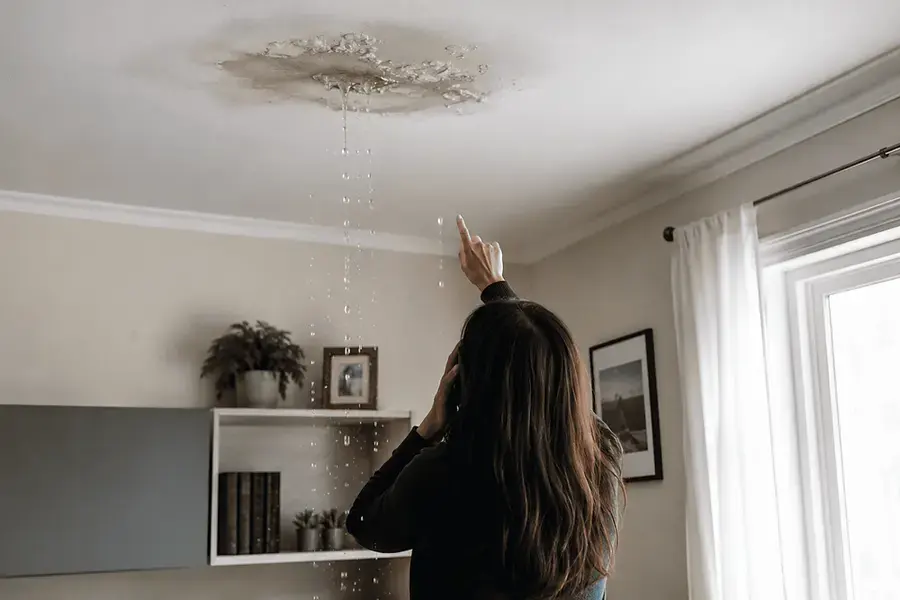
Around Newport Center and Big Canyon, many homes are stacked condos and townhomes that share ceilings, floors and walls. When a pipe or an appliance leaks in one unit, the water rarely stays there.
Key takeaways
- Unit to unit leaks are a common water problem in shared wall buildings, and the water often crosses ceilings and walls into more than one unit.
- The first steps are to protect people, shut off the source if it is reachable and photograph the damage.
- The association and the neighbor above should be told early, because the water source may be in a shared pipe or in the unit above.
- Each affected unit needs its own moisture readings and drying log.
- A sagging or bubbling ceiling should be left alone and opened under control, not poked.
Why condo leaks cross units
In a building with shared walls, ceilings and floors, water follows the path of least resistance. A leak from a bathroom, a washer or a supply pipe above soaks the ceiling below and runs down inside the wall cavities.
Newport Center and Big Canyon have many stacked condos and townhomes, so this is one of the most common water problems in that part of the city.
A pipe in one unit often runs through the same wall that holds the pipes of the next, so a single failed fitting can wet the units on both sides.
What to do in the first moments
The first few steps are about safety and about limiting the spread. They do not need special tools.
Shutting off the water is not always something a neighbor can do. Some buildings have a shutoff for each unit and some have one for a whole stack, so the manager may need to close it.
- Keep people and pets away from a ceiling that is sagging or dripping heavily.
- Move furniture and electronics out of the wet area, or cover them.
- Switch off power to any light fixture or outlet that is wet, if it can be done safely.
- Place buckets under drips and lay towels along the edge of the wet floor.
- Contact the unit above to ask them to shut off the water supply.
- Photograph the stain, the drip and any damaged belongings.
Who needs to be told
A condo leak involves more people than a house leak. The neighbor above may not know water is escaping, and the building may have a manager or an association that controls shared pipes.
Telling them early helps in two ways. It stops the source sooner, and it creates a record of when the problem was reported.
A written message, whether an email or a text, with the date and photos, is better than a phone call that nobody remembers later. It also shows how quickly the problem was reported.
The neighbor and the association
Ask the unit above to check for a running appliance, a failed fitting or an overflowing tub. Report the leak to the association or building manager in writing, with photos.
The insurer
Owners and neighbors may each have a policy, and which one responds can depend on where the water came from. Notify the insurer early and ask what documentation it wants.
How a leaking ceiling is handled
A ceiling that holds water can sag, and it can release a lot of it at once if it is punctured carelessly. A controlled opening lets the water drain safely and lets the joist bay dry.
A ceiling leak water damage crew finds the wet area with moisture meters, opens only what the readings call for and removes wet insulation behind it.
- Sagging drywall is cut out in a controlled way, not pushed through.
- Wet insulation is removed because it holds water against the framing.
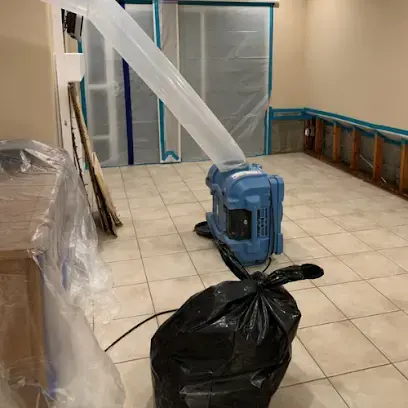
- The cavity is dried with air movers and a dehumidifier.
Drying every unit the water reached
A leak that crosses a shared ceiling can leave the unit below, a unit beside it and the source unit all wet. Each one needs separate readings, because the water behaves differently in each.
A condo water damage job keeps a log for every affected unit, so the work is documented for the owners, the association and the insurers.
The unit that caused the leak is not always the unit with the most damage. Water can pool on a floor above, run down inside a wall and show up several rooms away from where it started.
That is why every unit is checked with a meter instead of by sight. A ceiling that looks fine can still hold wet insulation above it.
- A separate moisture map and drying log for each unit.
- Photographs of each affected room before and after.
- A shared record that the association and each insurer can read.
Removing standing water first
Before any drying begins, standing water on the floor is pulled out. In a condo, that water can seep down through a floor into the unit below, so extraction matters more than it would in a single story house.
Water extraction is usually the first piece of work, and it sets the pace for everything else.
Extraction also protects the neighbors. A floor that is dry on top but wet underneath can keep sending water downward long after the first drip stops.
When the water is not clean
Water from a clean supply pipe is the easiest case. Water from a toilet, a drain or a backed up sewer is contaminated and is handled differently.
If the source above is a toilet overflow or a drain, the affected materials below are treated as contaminated and are usually removed instead of dried.
Gray water, such as water from a washing machine or a dishwasher, sits in between. It is not as dangerous as sewage, but it is not clean either, so wet carpet and pad are normally removed.
The source of the water is the thing to find out first, since it decides how the whole job is done.
Questions
Who should be called first when water comes through the ceiling?
The unit above should be asked to shut off the water, and the association or building manager should be told. A restoration team can start extraction and drying right away.
Why does the leak reach more than one unit?
Shared ceilings, floors and wall cavities let water travel sideways and down. A leak in one unit can wet the unit below and the ones beside it.
Should a bulging ceiling be popped to let the water out?
No. It is better to have it opened in a controlled way so the water drains safely and the ceiling does not collapse.
Do the other units need drying too?
Yes. Each affected unit gets its own readings and drying log, since the water can be in places that look dry.
What if the water came from a toilet?
That water is contaminated. Affected porous materials are usually removed and the area is cleaned and treated.
Who pays for the damage in the unit below?
That depends on the cause, the association rules and the policies involved, so it is a question for the association and the insurers. A clear record of the source and the readings makes it easier to answer.