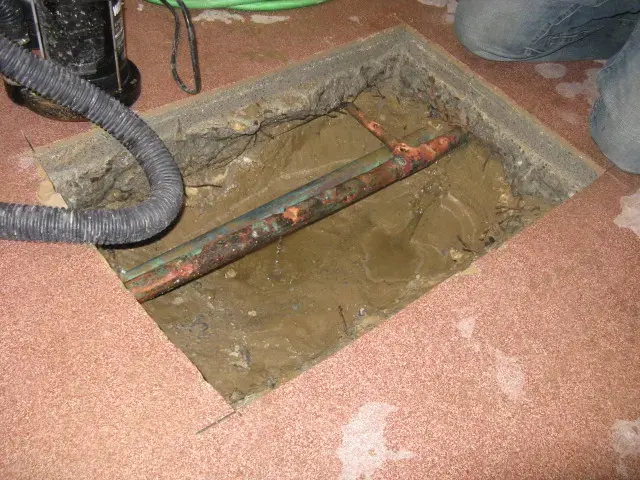
In many Newport Beach homes the copper supply pipes run under the concrete slab, out of sight. A leak there can run for weeks before it shows, and by then it has already soaked flooring, wall bottoms and the slab itself.
Key takeaways
- Common slab leak signs are a warm spot on the floor, the sound of running water, a meter that moves with everything off and damp flooring.
- Older copper pipes can develop pinhole leaks, and Newport Beach homes in the post war and 1960s to 1970s tracts often have supply pipes under the slab.
- The leak is located first, using thermal imaging and moisture mapping, before any floor is opened.
- Drying covers flooring, the bottom of the walls and the slab, and it continues until readings are normal.
- Fixing the pipe is a plumbing job; the water damage work and the pipe repair are two separate steps.
Why slab leaks happen in Newport Beach
Many homes in Newport Heights, Westcliff, Dover Shores and Eastbluff were built in the post war years and the 1960s and 1970s on a concrete slab. In that kind of construction the copper supply pipes often run under the slab instead of through the attic or the walls.
Copper lasts a long time, but it does not last forever. Over the years a pipe can wear through at a small spot and start to weep, which is a pinhole leak.
Newport Beach has a mild coastal climate with no hard freezes, so a failed pipe under a slab is not a cold weather problem. Age, corrosion and water pressure are the usual causes.
That matters when an owner is trying to guess the cause. A leak is more likely to be a slow pinhole than a sudden burst, which is why it can go unnoticed for so long.
What the coastal setting adds
Salt air in Newport Beach corrodes exposed fittings, hose bibs and water heater connections. That corrosion mostly attacks parts that are open to the air, but it is one more reason older plumbing in a coastal city deserves attention.
The signs worth checking
A slab leak hides under the floor, so the signs show up in other places. One sign alone does not prove a leak, but two or three together are a reason to investigate.
Signs can also be easy to misread. A warm spot can come from sun through a window, and a musty smell can come from many places, so the meter check and a moisture reading matter more than any single sign.
- A warm or hot spot on the floor, which can mean a leaking hot water pipe below.
- The sound of running or hissing water when every fixture is off.
- A water meter that keeps moving after all water use has stopped.
- A sudden rise in the water bill with no change in how much water is used.
- Damp carpet, lifting laminate or wood, or cracked grout and discolored tile.
- Musty smells coming from one part of a room or from along a baseboard.
A simple meter check at home
Before calling anyone, an owner can do a basic test. Shut off every faucet, appliance and irrigation system, then look at the water meter.
If the dial or the small leak indicator keeps moving, water is going somewhere. That does not say the leak is under the slab, but it separates a plumbing leak from normal use.
- Turn off everything that uses water inside and outside.
- Note the meter reading and wait without using any water.
- Check again; any movement points to a leak somewhere on the property.
How the leak is found before anything is opened
A good slab leak water damage response does not start with a jackhammer. It starts with finding where the water is going.
Thermal imaging shows temperature differences across a floor, and a moisture meter confirms which areas are actually wet. Together they map the damage and narrow down where the leaking pipe sits.
Why mapping matters
A moisture map keeps the work small. Only the flooring and wall sections that are wet get removed, and the rest of the home stays as it was.
What gets dried and removed
Water under a slab does not stay under it. It travels sideways and up, into baseboards, the bottom of walls and the flooring above.
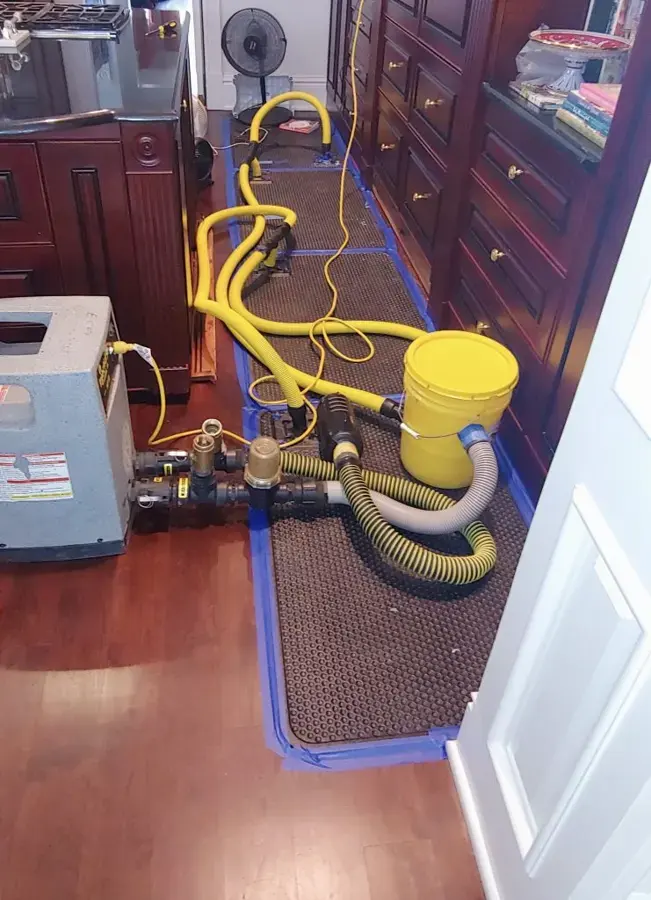
The drying plan usually covers three layers: the surface flooring, the walls and cabinets nearby, and the slab itself, which can hold moisture long after the floor looks dry.
Once the wet areas are mapped, structural drying sets up equipment so air moves across the floor and the wall bottoms while dehumidifiers pull moisture out of the room. A slab dries slowly, so the equipment can run longer than it would for a spill on a surface floor.
Cabinets and built in furniture need attention too. Water can run under toe kicks and sit in the cabinet base, where it is hard to see, so those areas are checked with a meter and opened only if the readings are high.
- Carpet and pad are lifted where the readings show moisture.
- Wood and laminate flooring may need drying mats or removal.
- Baseboards and the bottom of the drywall are opened where wet.
- The slab is dried with dehumidifiers and air movers until readings are normal.
Pipe repair and water damage work are separate jobs
Stopping the leak means a plumber repairs or reroutes the pipe. The restoration side deals with the water that has already soaked the home.
Doing both in the right order matters. Drying a home while a pipe keeps leaking only refills it, and repairing a pipe without drying leaves wet material behind.
Owners often ask which comes first. In most cases the leak is stopped or isolated first so the damage does not grow, and drying starts as soon as the source is under control.
Keeping the plumber's report and receipts helps a claim, since they show the cause and the date of the repair.
What a slab leak looks like when the pipe is in the wall
Not every hidden leak is under the floor. A pinhole leak can also sit inside a wall, where it needs a different approach.
A corroded pipe leak is traced inside the wall, the cavity is opened at the wet spot and then dried. The signs overlap with a slab leak, which is why a moisture map is useful in both cases.
Questions
How can I tell a slab leak from a leak in a wall?
A warm floor spot or damp flooring points toward the slab, while a stain or damp patch on a wall points toward the wall. A moisture map and thermal imaging confirm which it is.
Do copper pipes under the slab fail often?
Older copper can develop pinhole leaks over time. In Newport Beach homes with supply pipes under the slab, a hidden leak can run for a while before it shows.
Is a moving water meter proof of a slab leak?
No. It shows water is moving somewhere on the property. Locating the leak takes thermal imaging and moisture readings.
Does the slab need to be dried too?
Yes. Concrete holds moisture, so the slab is dried along with flooring and walls until readings return to normal.
Who fixes the leaking pipe?
A plumber repairs or reroutes the pipe. Restoration handles extraction, drying and removal of wet materials.
Can a slab leak damage walls and cabinets?
Yes. Water travels sideways and up from under the slab, so baseboards, the bottom of walls and cabinet bases can all be wet and are checked with a meter.